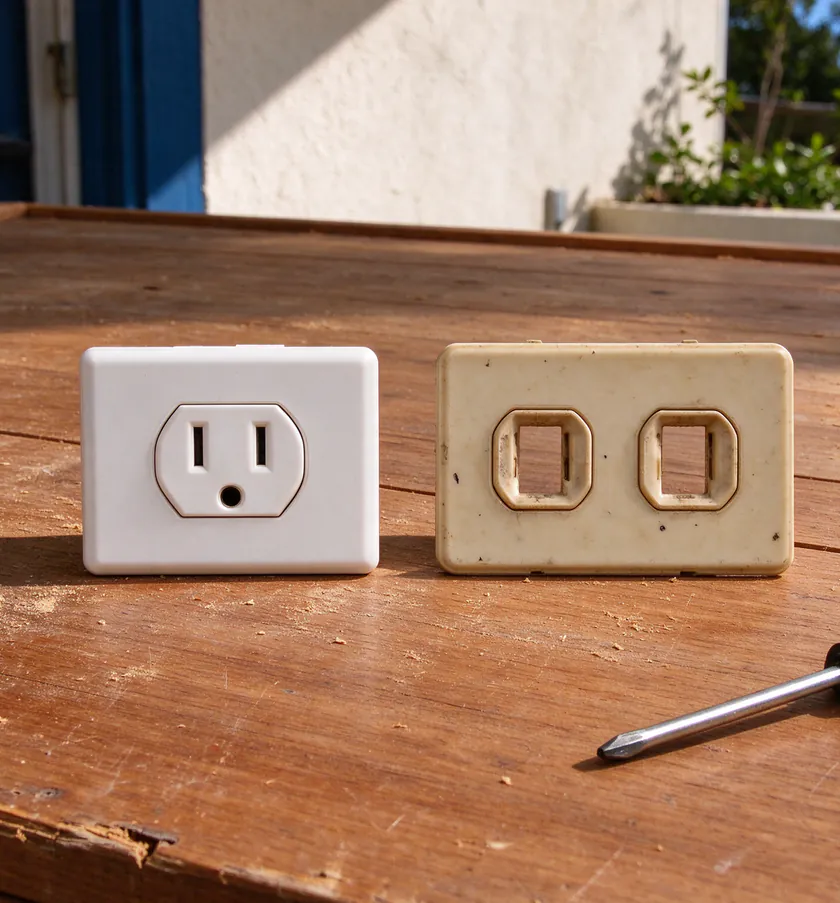
Yes, but a three-prong outlet on knob and tube is not grounded, because the system has no ground wire. The code allows three-prong replacements on ungrounded circuits with GFCI protection and a “No Equipment Ground” label, or after a new grounding conductor is run. A plain three-prong swap advertises a ground that is not there.
LA Knob and Tube replaces knob and tube wiring across Los Angeles, Pasadena, Glendale and South Pasadena, and grounding is one of the questions any assessment of an old circuit has to answer. This guide explains what the third prong does, why your old circuits lack it, which replacement options the code allows, and why the reading on a plug-in tester is not proof. None of this is do-it-yourself work; replacing outlets on century-old wiring means handling brittle, possibly energized conductors.
What the third prong is for
A circuit needs two conductors to work: the hot, which carries current out, and the neutral, which brings it back. The third conductor in modern wiring, the equipment grounding conductor, carries no current in normal use. It connects the metal parts of appliances, boxes and fixtures back to the panel and the grounding system. If a hot wire touches a metal case inside a toaster or a lamp, the ground gives the fault current a low-resistance path home, so much current flows that the breaker or fuse opens almost instantly.
Without that path, a fault can leave the metal case energized. Nothing trips. The next person to touch the case and a faucet, or a radiator, becomes the path. That is the shock-protection concern with ungrounded circuits, and it is a different hazard from the overheating and arcing covered in the dangerous or not guide.
Why knob and tube has no ground
Knob and tube predates the equipment grounding conductor in house wiring. Each circuit is two separate conductors on porcelain, and nothing else. That is the original design, explained in the knob and tube wiring guide, not a defect, and it was the norm when appliances were few and had no metal cases connected to anything. It means the two-prong outlets on a knob and tube circuit are honest: they offer exactly what the wiring provides.
Many old houses no longer look that way. Over the decades, two-prong outlets were swapped for three-prong ones so modern plugs would fit, without any ground being added. The guide to identifying knob and tube explains why three-prong outlets on the walls do not prove the wiring behind them is modern.
Why a plain three-prong outlet is worse than two prongs
A three-prong outlet with nothing on its ground terminal tells every appliance plugged into it that a ground exists. A refrigerator, a washing machine or a surge protector designed to send fault or surge current to ground has nowhere to send it. The person using the appliance has no way to know.
Some swaps go further. A jumper from the neutral terminal to the ground terminal, sometimes called a bootleg ground, makes the outlet look correct to a plug-in tester. It also connects the appliance’s metal case to the neutral, which carries current in normal use, so a loose neutral anywhere upstream can energize every case on the circuit. False grounds like this are one reason an assessment tests outlets instead of trusting their shape.
What the code allows when an ungrounded outlet is replaced
The California Electrical Code adopts the national code’s rules for replacing receptacles where no ground exists, in section 406.4(D), without amendment. The options, in plain terms:
- A two-prong replacement. A non-grounding outlet replaces a non-grounding outlet. It is honest about the circuit, and it is also exempt from the tamper-resistant requirement that applies to most other dwelling receptacles.
- A GFCI outlet. A ground-fault circuit interrupter receptacle can replace an ungrounded outlet. It must be marked “No Equipment Ground”, and no ground wire may be connected from it to outlets downstream.
- Three-prong outlets protected by a GFCI. Ordinary three-prong outlets can be installed downstream of a GFCI outlet or a GFCI breaker. Each must be marked “GFCI Protected” and “No Equipment Ground”.
- A grounding-type outlet with a new grounding conductor. Where a separate grounding conductor is run back to the panel or the grounding system, as the code permits for existing circuits, a normal grounded outlet can go in.
The GFCI options work because a GFCI does not need a ground to protect people. It compares the current going out on the hot with the current coming back on the neutral and trips when a few thousandths of an amp go missing, which is what happens when current leaks through a person. The AFCI and GFCI guide covers how that behaves on old circuits, including why GFCIs sometimes trip on knob and tube for reasons that have nothing to do with a person.
What the GFCI option does not do
A GFCI-protected, ungrounded three-prong outlet is safer for people than a plain two-prong one, but it is still ungrounded. Surge protectors that rely on a ground path cannot divert surges. Equipment whose instructions call for a grounded outlet, which can include computers, some kitchen appliances and medical devices, still needs one. And the GFCI does nothing about the age of the insulation, the condition of the splices or the protection at the fuse box.
Where a room genuinely needs grounded outlets, a new circuit is usually the better answer, because a new circuit brings a ground, modern insulation, arc-fault protection and the capacity for the loads the room actually has.
Why a tester’s reading is not proof
A plug-in outlet tester with three lights is a quick screen, not a verdict. It reads the voltages between the slots. It cannot tell a real ground from a bootleg jumper, a ground wire that goes nowhere, or a metal box that is not itself grounded. A GFCI-protected ungrounded outlet will usually read “open ground”, which is correct and expected.
Confirming a ground means tracing the grounding conductor and testing it back to the panel, which is the grounding check an electrician makes during a knob and tube inspection. That involves opening boxes and testing energized circuits, which is electrician’s work.
What it costs and what to ask for
Replacing an outlet on an existing circuit runs $150 to $350 each, a typical LA-area range. That figure is for standalone outlet work and is not added on top of a rewire, where new outlets are part of the job. When you ask for outlet work on an older house, ask which option under the code each outlet will use, whether any existing three-prong outlets have false grounds, and whether a new circuit would make more sense for rooms with heavy or sensitive loads.
If the answer is more than a few outlets, the conversation usually moves to partial replacement of the circuits involved, run through the attic and crawlspace where possible. And if the panel itself is also due, the panel upgrade vs rewiring guide explains why a new panel does not ground old branch circuits. If you have three-prong outlets on old wiring and are not sure what is behind them, call and ask for a grounding check as part of the visit.