Free printable
Knob and Tube Home Buyer Checklist
For buyers, sellers and owners whose insurer has asked about the wiring: what to ask the insurer and the electrician, which documents to collect, and a record of where partial work stops. Two pages, made to print.
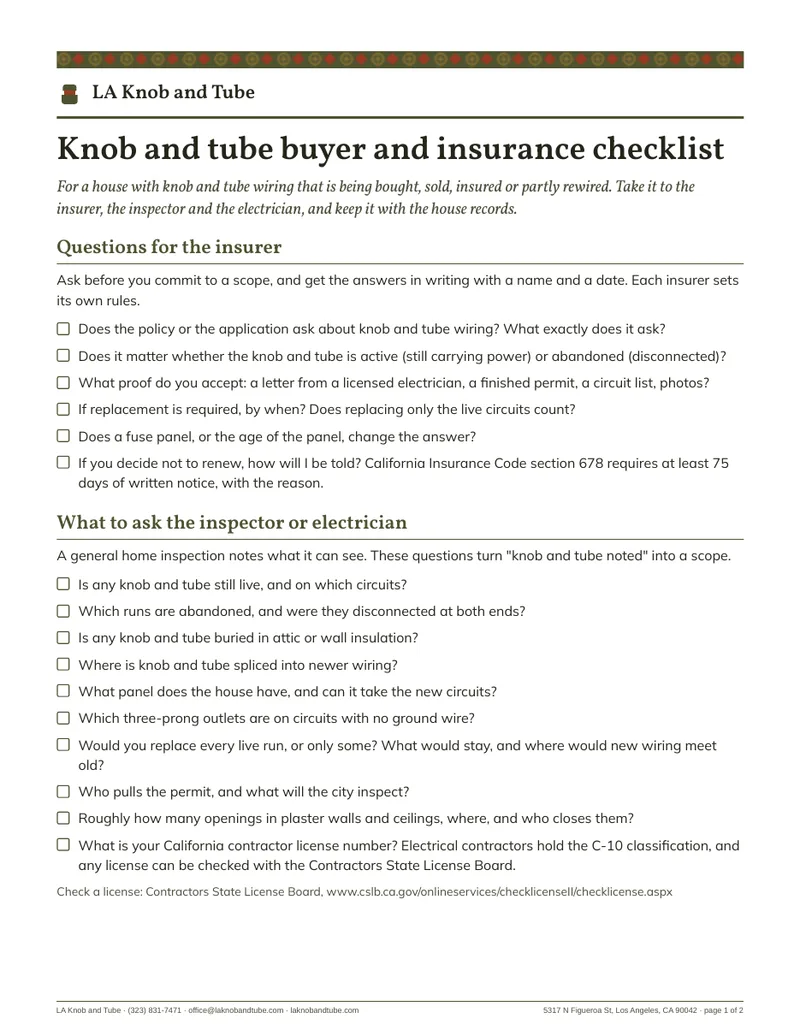
What the checklist covers
The same questions and records as the printable, so you can read them here first.
Questions for the insurer
Ask before you commit to a scope, and get the answers in writing with a name and a date. Each insurer sets its own rules.
- Does the policy or the application ask about knob and tube wiring? What exactly does it ask?
- Does it matter whether the knob and tube is active (still carrying power) or abandoned (disconnected)?
- What proof do you accept: a letter from a licensed electrician, a finished permit, a circuit list, photos?
- If replacement is required, by when? Does replacing only the live circuits count?
- Does a fuse panel, or the age of the panel, change the answer?
- If you decide not to renew, how will I be told? California Insurance Code section 678 requires at least 75 days of written notice, with the reason.
What to ask the inspector or electrician
A general home inspection notes what it can see. These questions turn "knob and tube noted" into a scope.
- Is any knob and tube still live, and on which circuits?
- Which runs are abandoned, and were they disconnected at both ends?
- Is any knob and tube buried in attic or wall insulation?
- Where is knob and tube spliced into newer wiring?
- What panel does the house have, and can it take the new circuits?
- Which three-prong outlets are on circuits with no ground wire?
- Would you replace every live run, or only some? What would stay, and where would new wiring meet old?
- Who pulls the permit, and what will the city inspect?
- Roughly how many openings in plaster walls and ceilings, where, and who closes them?
- What is your California contractor license number? Electrical contractors hold the C-10 classification, and any license can be checked with the Contractors State License Board.
Documents to collect
Keep these together. They are what an insurer, a lender or the next buyer asks for.
- The electrical permit and its final inspection sign-off. In the City of Los Angeles the permit comes from LADBS; in Pasadena, Glendale and South Pasadena, from the city building department.
- A circuit list: which circuits were replaced, which knob and tube runs were found live, and which were left in the walls disconnected.
- A photo of the panel and its labeled circuit directory, taken by the electrician when the work is finished.
- The written scope and quote, including what patching is covered.
- If knob and tube stays under new insulation: the electrical contractor's certification that the California Electrical Code requires, filed with the building department.
- Letters or emails from the insurer stating its requirements.
Partial-work boundary record
When only part of the house is rewired, write down where the new wiring stops. Fill this in with the electrician before the walls close.
- Date of work
- Contractor and license number
- Permit number
- Rooms and circuits replaced
- Live knob and tube left in service, and where
- Abandoned runs left in walls or ceilings, and how they were disconnected
- Where new wiring connects to old (junction box locations)
- Attic: insulated or not, and over what wiring
- Notes
Get the printable checklist
Send the short form and the download link appears right under it. If you would like a walk-through as well, say so in the message.
Call (323) 831-7471LA Knob and Tube5317 N Figueroa St, Los Angeles, CA 90042
office@laknobandtube.com