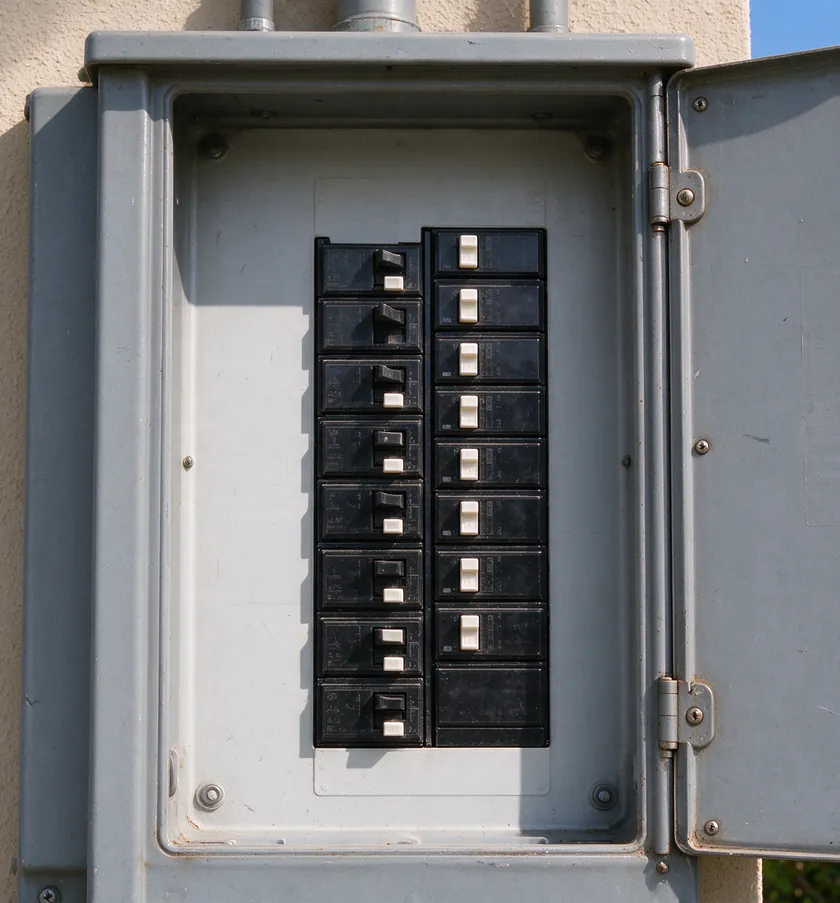
They help, within limits. A GFCI protects people from shock by tripping when current leaks out of the circuit, and it works without a ground wire. An AFCI senses the signature of arcing and trips before an arc can start a fire. Neither device repairs brittle insulation, adds a ground, adds capacity or fixes a bad splice.
LA Knob and Tube replaces knob and tube wiring across Los Angeles, Pasadena, Glendale and South Pasadena, and every replaced circuit in a living area ends up with arc-fault protection because the California Electrical Code requires it. This guide explains what each device actually senses, where the code requires them on new or replaced circuits, and how they behave on old circuits that stay in service.
What a GFCI detects
A ground-fault circuit interrupter compares two currents: the current leaving on the hot conductor and the current returning on the neutral. On a healthy circuit they are equal. If a few thousandths of an amp go missing, the current has found another way home, through water, a damaged appliance or a person, and the GFCI opens the circuit in a fraction of a second.
Because it compares hot and neutral, a GFCI does not need a ground wire to work. That is why the code allows a GFCI as a replacement for an ungrounded outlet, provided the outlet is labeled “No Equipment Ground”, as the three-prong outlets guide explains.
What a GFCI does not sense: overloads, loose connections that heat up, or an arc between hot and neutral. All of those keep the current balanced, so the GFCI stays closed. It is a shock device, not a fire device.
What an AFCI detects
An arc-fault circuit interrupter watches the shape of the current on the circuit. A loose terminal, a cracked conductor touching something it should not, or a nail through a cable produces arcing, a rapid, irregular pattern of current that a normal breaker ignores because the total current may never be high enough to trip it. The AFCI recognizes that pattern and opens the circuit.
That makes an AFCI the device most closely matched to the failure mechanisms of old wiring, described in the dangerous or not guide: loose connections, damaged insulation and poor splices that arc before they burn. It is a fire device. An AFCI breaker also provides the normal overcurrent protection of any breaker.
AFCI protection comes in two main forms. A combination AFCI breaker in the panel protects the whole circuit from the panel out. An outlet-branch AFCI receptacle, installed at the first outlet on a circuit, protects the wiring downstream of it. Dual-function devices combine AFCI and GFCI protection in one breaker or receptacle.
Where the code requires them
The California Electrical Code, the 2023 national code with California amendments, in force since January 1, 2026, sets the requirements for new and altered circuits.
Arc-fault protection on replaced circuits
Under section 210.12, when branch-circuit wiring in a dwelling is modified, replaced or extended in the areas the code lists, including kitchens, family, dining and living rooms, bedrooms, closets, hallways, laundry areas and similar rooms, it needs AFCI protection, from a combination AFCI breaker or an outlet-branch AFCI at the first receptacle. Extensions of six feet or less that add no outlets are an exception. In practice, nearly every knob and tube circuit replaced in a living area of the house gets AFCI protection.
Ground-fault protection by location
Section 210.8 lists the dwelling locations that need GFCI protection for receptacles, including kitchens, bathrooms, laundry areas, garages, outdoors, crawlspaces and areas near sinks. When knob and tube serving those spaces is replaced, the new outlets come with GFCI protection.
Related requirements
New receptacles in dwellings are tamper-resistant under section 406.12, and new cable includes an equipment grounding conductor. The legal in California guide covers how these rules apply to new work, and how existing wiring is treated.
How the devices behave on old circuits
Adding AFCI or GFCI protection to a circuit that stays on knob and tube is allowed, and on some circuits it is a sensible interim step. But old wiring can make the devices behave in ways that surprise owners.
Shared and crossed neutrals
Over a century of alterations, a knob and tube circuit’s neutral is sometimes tied to another circuit’s neutral, so current leaves on one circuit’s hot and returns partly on another circuit’s neutral. A GFCI or an AFCI with ground-fault sensing reads that imbalance as a fault and trips, sometimes immediately and sometimes only when certain lights or outlets are on. The device is doing its job. Finding where the neutrals cross is tracing work in the attic, the crawlspace and the boxes, described in the active and abandoned guide.
Old splices and devices
An AFCI that trips on an old circuit may be reacting to real arcing at a loose terminal or a failing splice, which is exactly what it is for. It may also be reacting to an old appliance or motor that produces a similar signature. Either way, the trip deserves a look rather than a reset and a shrug, and the inspection page explains how circuits are traced.
What still is not covered
Neither device changes the insulation on the wire. An AFCI may catch an arc from cracked insulation, but it cannot stop the insulation cracking. Neither device adds a ground, so equipment that needs a grounded outlet still does not have one. Neither adds capacity, so a bedroom circuit carrying a space heater and a window air conditioner is still overloaded, just better protected. And a device cannot correct a fuse or breaker that is larger than the wire, which is a separate fix an electrician makes at the panel. Never upsize a fuse yourself.
Mitigation or replacement
Devices make the most sense on circuits that are in sound condition, lightly loaded and staying in service for a while, perhaps because a partial replacement is planned in stages. They make less sense as a substitute for replacing circuits that are damaged, heavily altered or buried in insulation, and they may not satisfy an insurer that asks only whether knob and tube is still live.
When circuits are replaced, in a partial job or a whole-house rewire, the protection comes with the job: new cable with a ground, AFCI protection for living areas, GFCI protection where water is nearby and tamper-resistant receptacles, labeled at a panel with room for them. If your panel has no space for AFCI breakers, the panel upgrade vs rewiring guide explains how the two jobs fit together, and the replacement process guide shows where devices are installed in the sequence.
If a new GFCI or AFCI keeps tripping on an old circuit, leave it in place and call, because the trip is information about the wiring.