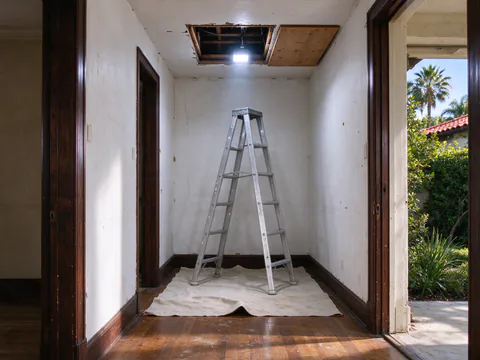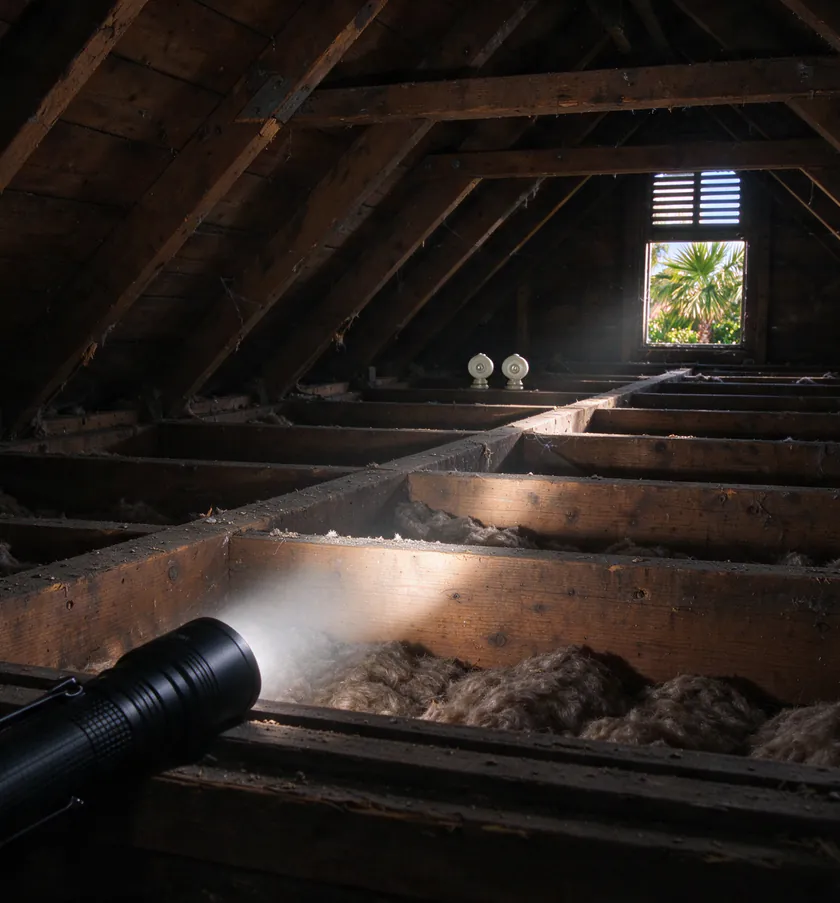
You identify knob and tube by looking, never touching. Its signature is two separate cloth-covered wires running inches apart on white porcelain knobs along joists, and through porcelain tubes where they pass through wood. Look from an attic hatch or crawlspace opening with a flashlight. Fuse boxes and two-prong outlets are supporting clues, not proof.
LA Knob and Tube replaces knob and tube wiring in Los Angeles, Pasadena, Glendale and South Pasadena, and this guide is how to identify knob and tube wiring before anyone visits, so you can describe what you have. It covers where to look, what each clue means, what not to do, and why the most important answer, whether the wiring is still live, cannot be seen from the outside.
Before you look: the safety rules
Treat any old wiring as if it is energized, because it may be. Do not touch, move, pull or tug at wires, knobs, tubes or insulation. Do not climb into an attic to get closer; stand on the ladder at the hatch and use a flashlight. Do not step on or brush against wiring in a crawlspace. Do not move attic insulation to see what is under it. Do not open outlet or switch boxes or remove cover plates, and at the fuse box, look only with the door open. And do not use a non-contact tester or plug-in tester to try to sort out what you are seeing.
Brittle rubber insulation can crack off at a touch, leaving bare copper. The dangerous or not guide explains why disturbing old wiring is one of the ways it gets worse.
In the attic
Where an older Los Angeles house has an attic above the ceilings, that is usually where knob and tube is easiest to see. From the hatch, look along the tops of the ceiling joists and the sides of the rafters for:
- Porcelain knobs. Small white or off-white spools, roughly the size of a thread spool, nailed to the wood. Each holds one wire off the surface.
- Two wires running apart. Single conductors, usually dark cloth-covered, running in parallel several inches apart, one per knob. Modern cable bundles its conductors in one jacket; knob and tube keeps them separate.
- Porcelain tubes. Short white tubes set into holes drilled through joists, with a single wire passing through each.
- Drops to fixtures. Pairs of wires turning down toward ceiling lights, sometimes covered in a woven cloth sleeve called loom where they enter a box.
Also note, without touching, whether insulation covers or surrounds the runs. Knob and tube under loose-fill or batts matters for both safety and code, as the attic insulation page explains.
In the crawlspace
Where a pre-war LA house sits on a raised wood floor over a crawlspace, the original wiring often runs along the floor joists to reach outlets in the rooms above. From the access opening, look for the same knobs, tubes and separated wires on the underside of the floor framing. Crawlspaces can be tight, damp and full of debris; if you would have to crawl in to see, leave it for the inspection.
At the fuse box or panel
A fuse box with screw-in round fuses, often with a glass window, is a strong era clue. Knob and tube circuits were originally protected by fuses, and a house with only a few fuse positions for the whole house usually has original branch circuits somewhere. Look only at what is visible with the door open. Do not remove the cover, and never change a fuse to a larger size.
A modern breaker panel does not rule out knob and tube. Panels were often replaced while the branch wiring stayed, and old circuits were reconnected to new breakers. The panel upgrade vs rewiring guide explains why a new panel does not remove old wiring.
In the rooms
Rooms give weaker clues, because outlets and switches are the parts most often replaced. Look for:
- Two-prong outlets, especially with few outlets per room
- Push-button light switches, with two round buttons instead of a toggle
- Ceiling fixtures with pull chains and no wall switch
- Three-prong outlets in an old house with no remodel, which may have been swapped onto ungrounded wiring
None of these proves knob and tube. Two-prong outlets fit other ungrounded wiring too, and a three-prong outlet says nothing about the wire behind it, as the three-prong outlets guide explains. Cloth-covered cable in a single jacket is a different, later system; the knob and tube vs cloth wiring guide shows how they differ.
Why modern cable does not mean it is gone
The most common identification mistake is taking a remodeled house at face value. A kitchen rewired in the 1980s, a bathroom redone later, a new panel and fresh outlets can make a house look modern from every room, while bedroom and hallway circuits still run on original knob and tube in the attic. The reverse also happens: old runs left in an attic after replacement, disconnected and dead.
Seeing modern cable at the panel or in one attic bay tells you that some wiring was replaced, not that all of it was. Where modern cable meets old single conductors, the junction may be a splice feeding new outlets from old wiring. Those meeting points are what an electrician looks for first, and the active and abandoned knob and tube guide explains how live and dead runs are told apart.
What to write down for the visit
Note where you saw porcelain, whether it was in the attic, crawlspace or both, and roughly which rooms it sits above or below. Note the type of fuse box or panel and how many circuits it has. Note any two-prong outlets, push-button switches, insulation over old runs and any warning signs such as a warm plate or a burning smell. Photos taken from the hatch help.
That list makes a knob and tube inspection faster, because the first visit can go straight to mapping which circuits are live, where they run and how new cable could reach each room. If you are in escrow, the buying guide covers timing. When you have your notes, call and describe what you saw.