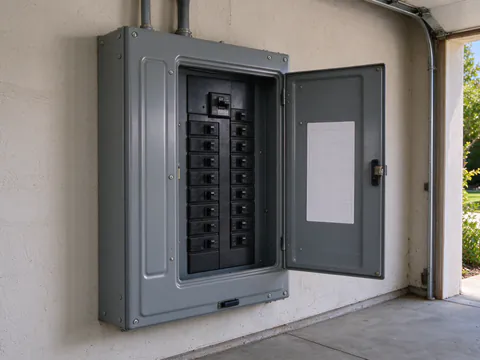
LA Knob and Tube handles both panel upgrades and knob and tube rewiring in Los Angeles, Pasadena, Glendale and South Pasadena, and the panel upgrade vs rewiring question comes up on almost every older house. They are different jobs. A panel upgrade replaces the equipment where circuits start. Rewiring replaces the branch circuits that run from it to the rooms. A new panel leaves every knob and tube circuit exactly where it was.
Plenty of houses need both. The useful questions are which one the house needs now, and in what order.
What each job covers
| Panel upgrade | Rewiring | |
|---|---|---|
| What changes | The panelboard and breakers; sometimes the service, meter and mast | The branch circuits: cable, boxes, devices and their connections |
| What it fixes | Capacity, breaker space, worn or unsafe equipment, fuses | Old conductors, missing grounds, open splices, too few circuits |
| What it leaves alone | Every branch circuit, including knob and tube | The panel, unless it is replaced as part of the job |
| Walls and ceilings | Usually none opened | Openings at boxes and where routes cross framing |
| Utility involvement | Where the service or meter changes | Usually none |
| Typical cost | $2,500 to $5,500 in the LA area, 100 to 200 amps, same location, no utility-side work | $10 to $20 per sq ft of living area in the LA area; $12,000 to $35,000 as a national budgeting range for a whole house |
Both cost figures exclude plaster restoration and any work on the utility side. The Los Angeles cost guide breaks them down.
Why a new panel does not remove knob and tube
The panel is where circuits begin. Knob and tube is what the circuits are made of, out in the attic, the crawlspace and the walls. Swapping a fuse box for a breaker panel changes the device protecting each circuit, not the wire. LADBS permit descriptions in the City of LA show the two being done together, such as a 90-amp panel upgraded to 200 amps on a house with knob and tube, and a 200-amp main installed with a complete rewire of the old knob and tube. They are listed as two pieces of work because they are.
A panel swap can also create a new problem. Old circuits need protection sized for the old wire. When a fuse box is replaced and the old circuits are moved onto breakers sized for modern cable, the wire loses the protection it depended on. That is the same risk as an oversized fuse, created by equipment that looks new, and one reason the main knob and tube guide treats panel and branch wiring together. A panel upgrade that keeps knob and tube circuits in service has to size their breakers to the old conductors.
When the panel can stay
A rewire does not automatically need a new panel. The panel can usually stay when:
- It has the capacity. A load calculation, which adds up the house’s lighting, receptacle and appliance loads by the code method, shows the service can carry the rewired house.
- It has the space. There are enough breaker spaces for the new circuits, which usually outnumber the old ones.
- Breakers are available for it, including AFCI breakers for the replaced living-area circuits.
- It is in sound condition, with no heat damage, corrosion or recalled equipment.
When the panel has to change
The panel usually changes when the house still runs on fuses, when it is full and the rewire adds circuits, when the service is too small for the planned loads, or when the equipment itself is unsafe or no longer supported. Older homes are more likely to have 100 amp service or less, according to research by UCLA and Lawrence Berkeley National Laboratory on California panels, and a rewire that adds kitchen, bathroom, laundry and air conditioning circuits often outgrows it. Future loads count too: the state’s home-sale electrical advisory warns that limited capacity can make it hard to add solar, electric heating, electric water heating or EV charging. The electrical panel upgrade page covers that work in detail.
Panel compatibility with the new circuits
Compatibility is the quiet decision in this comparison. California’s electrical code requires arc-fault protection on replaced branch circuits in kitchens, living areas, bedrooms, hallways, closets, laundry areas and similar rooms, either as a combination AFCI breaker or as an outlet-type AFCI at the first receptacle. AFCI breakers are made for particular panel types. Where the existing panel has no AFCI breaker available, the rewire can use outlet-type AFCIs, or the panel is replaced. The AFCI and GFCI guide explains the difference.
A modern panel also gives the rewire room to grow: separate circuits for the kitchen counters and bathroom, a dedicated laundry circuit, and spare spaces for later work. It does not add a ground to an old circuit, and it does not make a three-prong outlet on knob and tube safe.
The utility side
A panel upgrade that changes the service or moves the meter needs the utility, and each city in this area has a different one.
City of Los Angeles (LADWP). LADWP says LADBS requires an electrical permit before an inspector can go to the jobsite, and that the meter spot must be verified with LADWP before a new meter panel is installed. Single-family meter spots up to 320 amps can be requested online, and a meter is generally set within 10 working days when no other LADWP work is needed. Underground services take longer to plan. LADWP says it generally charges no installation fee when the existing service can carry the new demand; work in the street or on a transformer is priced case by case.
Pasadena (Pasadena Water & Power). Pasadena’s fee schedule lists $1,238.19 for a 200-amp overhead service and $3,190.81 plus civil construction for an underground one. Whether a specific upgrade falls under those charges is confirmed with Pasadena Water & Power.
Glendale (Glendale Water & Power) and South Pasadena (SCE). Each has its own service-planning process. Requirements and charges are confirmed per address with the utility.
In an HPOZ, moving a mast or meter onto a street-facing wall can draw preservation review; the historic homes guide covers placement.
Order of work when the house needs both
When both are in scope, the panel usually goes in early, so new circuits land directly on new breakers and the old circuits are moved over on correctly sized protection until they are replaced. The rewire then proceeds circuit by circuit. The Los Angeles rewiring permit guide covers how the inspections fall. Doing them under one permit and one plan avoids paying twice for the same access and the same inspection visits. Where budget forces a split, doing the panel first is reasonable only if it is sized and laid out for the rewire that follows.
A quick way to decide
If the problem is fuses, capacity or a failing panel, start with the panel. If the problem is the wiring itself, an insurer’s question about knob and tube, an inspection finding or ungrounded circuits, the answer is rewiring, whatever the panel looks like. The knob and tube inspection maps both at once, the whole-house rewiring page covers the branch-circuit side, and the rewiring quote checklist shows how a quote should separate the two. Call or request an estimate when you want both measured on your own house.