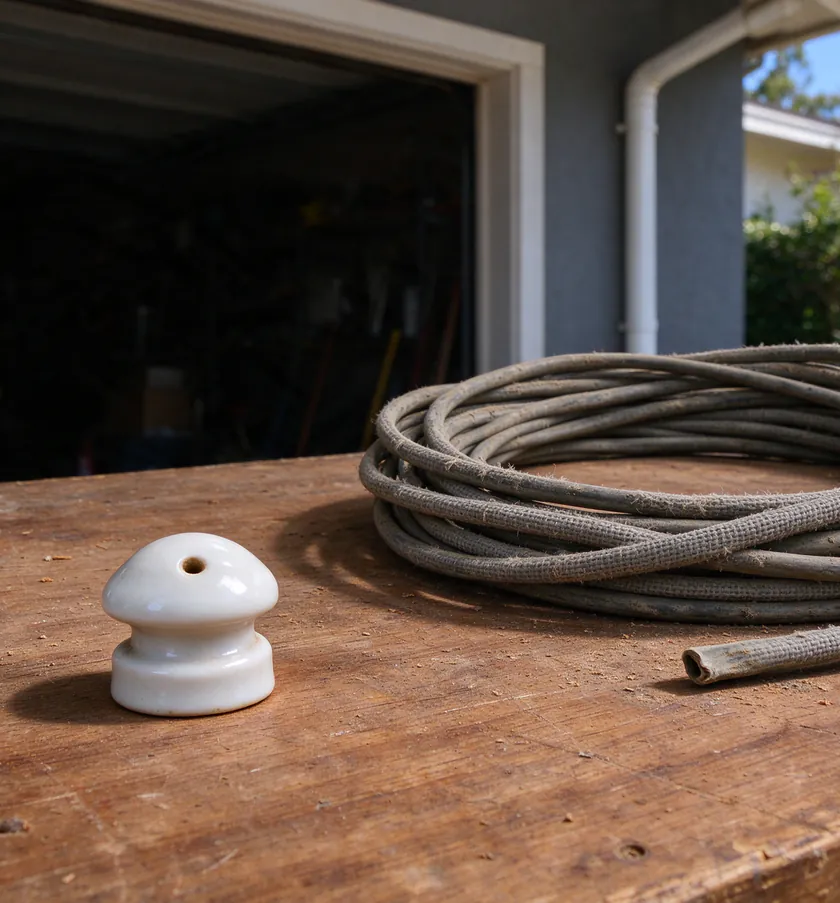
LA Knob and Tube replaces old wiring in Los Angeles, Pasadena, Glendale and South Pasadena, and the first question on many calls is knob and tube vs cloth wiring. The short answer: knob and tube is two separate wires run apart through open framing on porcelain knobs and tubes. “Cloth wiring” usually means early sheathed cable, two rubber-insulated wires wrapped together in one woven jacket and stapled to the wood. Both are old and usually ungrounded, but they age differently.
That difference matters because it changes how a house is assessed and, sometimes, what an insurer asks for. It rarely changes how the replacement is done: both are retired circuit by circuit and replaced with modern grounded cable, as the replacement process guide describes.
The two systems side by side
| Knob and tube | Cloth-sheathed cable | |
|---|---|---|
| How it is built | Two single wires, each on its own porcelain knobs, several inches apart | Two insulated wires bundled together inside one woven jacket |
| How it is fastened | Knobs nailed to framing; tubes through drilled holes | Stapled or strapped flat along joists and studs |
| Connections | Often soldered and taped splices in open air | Usually inside metal boxes |
| Cooling | Each wire sheds heat to open air | Wires sit together inside the jacket |
| Ground wire | None | Usually none in early cable; later versions sometimes had one |
| Era | Late 1800s into the 1930s | Roughly the late 1920s into the 1950s |
How knob and tube is built
Knob and tube runs each conductor on its own. Along a joist, the wire is tied to small porcelain knobs that hold it off the wood. Through a joist or stud, it passes inside a porcelain tube. Near boxes and other tight spots, installers slipped a flexible cloth sleeve called loom over the wire. The hot and neutral of one circuit can travel along different joists and meet only at the fixture.
That separation was the safety idea: a damaged spot on one wire could not easily short against the other, and open air carried heat away. The main knob and tube guide explains why the design held up for decades and what changed around it.
How cloth-sheathed cable is built
Early nonmetallic sheathed cable put both conductors into one assembly. Each copper wire got its own rubber insulation, often a paper wrap, and then the pair was wrapped together in a woven cotton jacket treated to resist moisture. It went in faster than knob and tube, because one run of cable replaced two separate runs and dozens of knobs, and it connected inside boxes rather than at open splices.
Cable with a metal armor jacket, sometimes called BX, was also used in the same decades and turns up in some LA houses. It looks different, a spiral of steel, but it raises a similar grounding question, because the armor of older cable is not always a reliable ground path.
Rubber and cloth insulation: what actually ages
In both systems, the cloth is not the insulation. The cloth protects the rubber underneath from abrasion. The rubber is what keeps the copper from touching anything, and rubber compounds of that era harden with heat and time. Left alone, hardened rubber can stay in place for decades. Bent, pulled or stepped on, it cracks and flakes off, and bare copper is left behind.
Where the two systems age differently is heat. Knob and tube conductors sit apart in open air, so they run cool unless insulation is piled around them. Cloth-sheathed cable holds two conductors side by side in a jacket, and where it runs through hot attics or is overloaded, the rubber between the wires can get hotter. Neither is a reason to panic. Both are a reason not to handle old wiring to see what condition it is in. The guide to whether knob and tube is dangerous covers the warning signs that matter.
Grounding: neither system started with one
Knob and tube has no equipment grounding conductor at all. Early cloth-sheathed cable usually had two wires and no ground either. Cable carrying a ground wire appeared later, and grounding-type receptacles became the norm for new work around the 1960s. Some later cloth-jacketed cable did include a small ground, so the only reliable answer for a specific circuit is a test.
A three-prong outlet tells you nothing about either. Over the years, many two-prong outlets were swapped for three-prong ones without any ground being added. The guide to three-prong outlets on knob and tube explains what testing shows and what GFCI protection can and cannot do on an ungrounded circuit.
Why both can show up in the same Los Angeles house
The Census Bureau counts 19.1% of homes in the City of Los Angeles as built before 1940, and 27.9% before 1950. A house in the first group was likely wired with knob and tube. A house finished in the 1940s may have cloth-sheathed cable from the start, or a mix, depending on the builder.
Then come the remodels, which the active and abandoned wiring guide shows can leave old runs live in unexpected places. Where a pre-war house had a kitchen redone in the 1950s or a room added on the back, the new work was often cloth-sheathed cable, sometimes spliced straight into a knob and tube run in the attic. Later still came plastic-jacketed cable. LADBS permit descriptions in the City of LA include jobs that replaced knob and tube while upgrading a panel, which is a reminder that a house can carry several generations of wiring at once. Where a house has that kind of history, the useful question is not which system it has but which circuits run on which, and where the splices between them are. The knob and tube inspection maps exactly that.
Is cloth wiring safer than knob and tube?
Not in a simple way. Cloth-sheathed cable has connections in boxes, which is an improvement over open splices, and it is less likely to have been tapped informally along the way. Knob and tube has better heat shedding, as long as nothing covers it. The weakest point in either is usually where someone joined new work to old, or where insulation, storage or a remodel disturbed the run.
California’s restriction on insulating over wiring is written for knob and tube specifically, under section 394.12 of the electrical code, which is covered on the attic insulation page. Old cloth cable buried in insulation is still a condition an electrician would want to look at before the attic is closed up.
What it changes about replacement
For a rewire, the two systems are handled the same way. Each old circuit is identified, a new grounded circuit is run to the same rooms, usually with more outlets, and the old run is disconnected at both ends so it cannot be energized again. Runs that are easy to reach can be pulled out; the removal page explains when that is worth doing.
The difference shows up in planning. Cloth-sheathed cable stapled along framing is sometimes easier to trace and occasionally useful as a guide for a new route. Knob and tube routes tend to split hot and neutral, which takes longer to map. A partial replacement has to record both kinds of old circuit in the list of what remains. A whole-house rewire retires all of them.
Looking without touching
From a safe distance, with a flashlight, the clue is spacing. Two single wires several inches apart on white porcelain are knob and tube. One flat or round woven cable, stapled along the wood, is cloth-sheathed cable. Do not move insulation, pull on wires or open boxes to check. The identification guide shows what to look for and where. When you want the circuits sorted properly, a call or an estimate request starts with a circuit map of the whole house.